 Contact Us
Contact Us
Contact Us
In 2026, AI in iGaming is no longer a "cutting-edge trend" from conference decks — it is a working tool that directly impacts project unit economics. Platforms that use predictive analytics retain players longer, spend less on bonuses, and achieve higher LTV from the same traffic volume. Here is how it works in practice — and why operating without these tools in 2026 makes it hard to compete.


Most operators still work in a reactive mode: a player stops logging in — send a bonus. A player makes a large deposit — flag as VIP. This is a lagging model: money is already lost or the player has already made their decision before the operator reacts.
Predictive analytics flips this order. An ML model evaluates player behaviour before a key event occurs: before the first deposit, before churn, before the transition to a VIP segment. The operator acts ahead of time — and this fundamentally changes the economics of retention.

One of the most underrated ML use cases in iGaming is estimating a player's potential LTV before they make their first deposit. The model analyses behavioural signals: device type, traffic source, registration time, browsing depth, and lobby navigation patterns.
Based on this data, players are automatically placed into segments with different welcome offer logic. High-potential segments receive an enhanced bonus and fast VIP onboarding. Low-potential segments receive a minimal or no bonus — preventing bonus abuse from inflating costs.
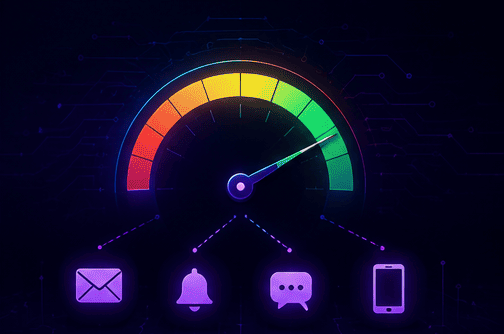
Churn prediction is the most mature ML use case in iGaming. The model trains on historical data and identifies patterns that precede player departure: declining session frequency, shrinking average deposit, shifting session times, switching from live formats to slots.
Once a player enters the at-risk zone, the platform automatically triggers a personalised communication chain — without any manager involvement. In most cases this means email, push, or SMS with a specific offer tied to that player's history — not a generic "we miss you" template.

In 2025–2026, operators who hand out the same welcome bonus and identical free spins to their entire player base consistently achieve worse margins than those who have configured personalised distribution. AI allows optimisation not only of bonus size, but also format, send timing and wagering requirements.
Result: the same bonus budget generates 30–50% more real repeat deposits.

An important point: predictive analytics is not a plugin you can attach to any engine. It requires a specific platform architecture and data access. Without this, ML models either do not function or produce inaccurate predictions that do more harm than good.
"Off-the-shelf" platforms where the back office is just a transaction list are not suitable for predictive analytics. This is one of the key reasons why operators who purchase source code with full architectural control gain a long-term advantage: they can build this infrastructure themselves.

Operators who implemented predictive analytics in 2024–2026 report consistent improvement patterns. It is important to understand: AI does not "magically" increase LTV — it eliminates losses in areas where money was leaking unnoticed.
The key takeaway: in 2026, competitive advantage is not the number of slots or bonus size — it is how precisely the platform understands what a specific player needs at a specific moment.
AI and predictive analytics in iGaming 2026 are no longer optional for "large operators" — they are
a baseline requirement for staying competitive. Platforms without event tracking, flexible CRM and bonus
load control lose the retention battle before they even start competing for traffic.
SoftIGaming builds platforms with architecture ready for predictive analytics: full event logging,
a flexible back office, ML integration APIs and transparent segment-level analytics. If you want to
discuss building a retention system from day one — reach out on Telegram and we will walk through
your situation and show how it is implemented in our engine.